
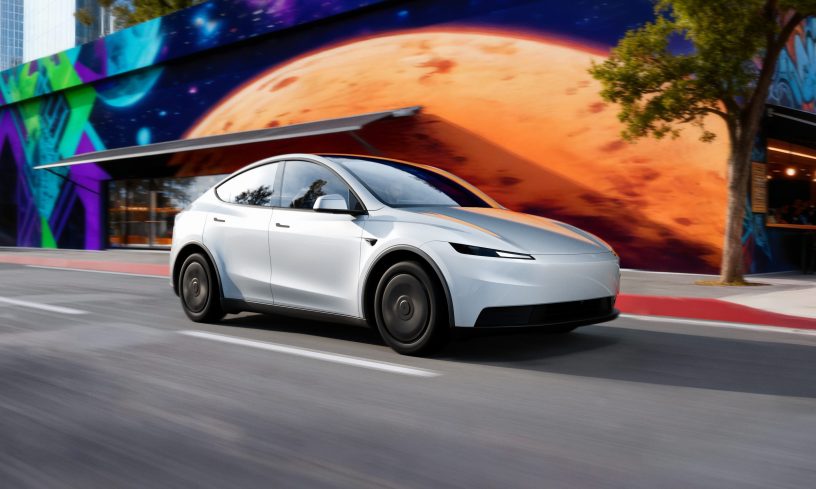
Tesla has introduced (and later discontinued) based model versions of the Model 3 and Model Y, the so-called ‘Standard’ trim level more than a few times. Typically, this meant a smaller capacity battery (or software locked to approximate one) with lower EV range and rear-wheel drive only. The last truly base model was introduced in Q1 2019 in the immediate aftermath of the automaker hitting the 200,000 sales cap and beginning a phase down of EV tax credit eligibility… feeling déjà vu? Read on.
Back then, it meant lower standard range, 220 miles down from 240, a slightly slower 0-60 time and a reduction in interior amenities. It was the ‘$35,000’ Tesla promised at the initial introduction of the Model 3, though this short lived 2019 ‘Standard Range’ was actually $36,200 after destination, and was only introduced after the $7,500 tax credit was history, not exactly what consumers were expecting from that early promise. That model stripped down the interior feature set, and much like its 2026 counterpart, had cloth seats, manual seat and steering adjustment, and even went further with a stripped out center console. For a mere $2,000 savings over the then newly renamed Standard Range Plus, it hardly seemed worth it. And Tesla seemed to agree, in fact not only did Tesla make this version only available by special order (meaning no models available for purchase at a Tesla dealer), even in the press release announcing the Standard Range, Tesla tried to pitch consumers on upgrading to the Standard Range Plus with this line: “For 6% more money, you get 9% more range, more power, and an upgraded interior.”
About six and a half years later, once again the familiar formula rolls out. Standard model with downgraded range, stripped out feature and of course a lower price point hits the market just as a federal tax credit fades away. Back then, the Model 3 gave up those features for a $2,000 price cut right as the tax credit cut in half to $3,750. This time, the price goes down $5,500 right as the $7,500 tax credit goes away completely. At that time a Model Y wasn’t yet on the market, today it too gets a stripped down, cut price variant. But before we get to whether the price cut is worth the feature and spec downgrades or what really seems to be going on with the motivation behind these models, let’s first review the changes afoot here.
Starting with the Model 3, the Standard trades the following in order to cut the price by $5,500. So what do you give up for the not inconsequential savings?
- 42 miles of range, an 12% cut from 363 to 321
- Slower stated 0-60 MPH time of 5.8s versus 4.9 s
- Unavailability of red, blue or silver exterior paint colors (leaving gray, white & black)
- 13% reduction in charging rate
- Manual steering wheel adjustment and exterior mirror folding
- Cloth seat inserts instead of perforated ‘vegan leather’
- downgrade of vehicle audio system (oddly the newly renamed Premium gets the same audio downgrade)
- Deletion of:
- FM radio
- ambient interior lighting
- ventilated front and heated rear seats
- 8” rear seat touchscreen
- Adaptive shocks
- Standard autosteer (You can get it back if you pay $8,000 for Full Self-Driving)
Interestingly, 18” wheels remain, but the otherwise standard ‘Photon’ wheels are replaced with a hubcap like ‘Prismata’, the only exterior design differentiation the Model 3 Standard gets from the newly renamed Premium trim, unlike the Model Y, which we will get to shortly. So is the Standard and its 12.5% discount from the Premium ($38,630 down from $44,130) worth the feature sacrifice? Not unless your objective is to get the least costly brand new Tesla but somehow weren’t able to pull forward your purchase to get the $7,500 tax credit, unlike the tens or even hundreds of thousands of others who powered Tesla’s record-breaking quarter.
But if the value equation for the Model 3 Standard seems a bit shaky, just wait until you see what lies before you on the Model Y front. Here the savings are $5,000 or a 10.7% discount from the Premium. Not only do you give up all of the same range (down from 357 miles to the same 321 as the Model 3 Standard, about a 10% decline) and gear as the Model 3 Standard does, but the Model Y also strips down the exterior & interior much further. The Y Standard also loses the HEPA filter of the Y Premium (apparently all Model 3 trims still go without this) and strangely the 0-60 time degradation is considerably worse at 6.8s versus 5.4s adding far more time relative to the Model 3 counterparts.

Unlike the relatively minor changes to the 3’s interior, the Y suffers a full design decontenting, leaving a minivan-like open console storage area
It gets worse. While the early rumors suggested the Standard would ditch its glass roof for a metal one, the production model will keep a glass roof, but it is now covered up by a cloth headliner. Apparently, this glass is not acoustically laminated nor coated with heated rejection material, so the cloth becomes necessary to address both noise and heat and the glass is opaque so it’s not possible to see through it anyway. How much, if anything, is saved per vehicle to justify all of that production complexity is unknown. For the 2002 model year, Toyota famously discontinued offering hand-crank windows and just made power windows standard. Why? Because it was actually most cost effective to forgo the engineering and production cost of hand-crank windows and give all 2002 and later Camry buyers power windows. The Tesla strategy here seems to be the polar opposite.
Worse yet, the 2026 Model Y Standard has the dubious distinction of becoming the first Model Y equipped with 18” wheels. The ‘Apeture’ wheels (yes that’s right, apparently yet another new 18” wheel design) which like the Model 3 Standard’s Prismatas have a hubcap-like appearance and are required to get even the lower range numbers quoted. But Tesla generously allows you to get back the same 19” ‘Crossflow’ wheels as are standard on Premium trim… for an additional $1,500. But be forewarned, if you do, the range collapses even further to 303. As a reminder, the Premium with the exact same wheels yields 357 miles. Spec’ing the Y Standard this way is absurd, simply offering this option seems to be strictly to demonstrate why this trim should not even exist as the delta to the Premium drops to $3,500 and the range gap is exacerbated considerably, now a 7.5% discount with a 15% haircut to range.

Smaller 18″ Apeture wheels and a simplified nose. Want to add those 19″ Crossflows to the Standard? Hope you like low EV range and mediocre savings.
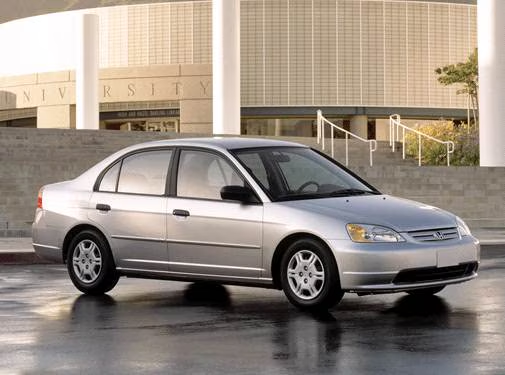
About those exterior and interior changes, the Y Standard’s somewhat cleaner front-end design is pleasantly simple with a rounder look & smooth uninterrupted surfacing in place of the full with LED light bar. However, creating a new design that in an alternate universe might have been enough to justify a model refresh simply for decontenting purposes is a level of poverty-spec signaling not seen since the days of the Civic or Accord DX trim and it’s unpainted mirrors, door handles and blanked out space instead of stereo head unit. Once again, it’s quite questionable how much or if at all the development costs, production complexity are worth the small per unit cost savings. And the stripped out center console, far beyond the decontenting the Model 3 Standard’s interior gets, certainly isn’t helping the penalty-box impression this trim level exudes.
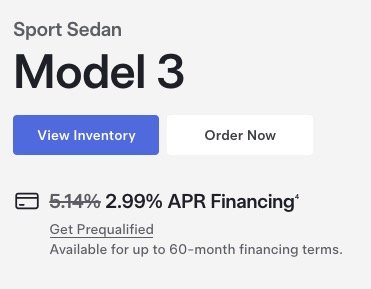
Could it possibly get any worse? Yes. The Model 3 & Y Standard (at the time of publishing) do not qualify for the special APR rates the Premium trims gets: 2.99% for the 3 Premium and 3.99% for the Y Premium. On a Model 3, the difference between the promotional 2.99% on a Premium and the standard rate of 5.14% (no pun intended there) on a Standard trim amounts to a total of $3,780 over 60 months, far less than the $5,500 retail price difference. For the Y which has a higher promo rate, the difference is $4,260, still meaningfully less than the $5,000 retail price delta.
Another aspect, not often considered upfront during a vehicle purchase decision is what will the resale value of said vehicle be down the line. It’s always an educated guess what a vehicle would be worth in the future and why the industry depends on companies like ALG to make determinations they can take to the bank (literally). That said, it’s not hard to predict that removing a host of desirable features and reducing the range of an EV considerably might result lower appeal on the second-hand market. In all likelihood, the $5,000-$5,500 added price of the Premium model will likely hold its value quite far into the lifecycle of these vehicles and thusly a buyer of those cars is likely to get back most if not all of their added purchase price when it comes time to sell.
So with all those strikes against the 3/Y Standard trim models, why do they exist? Firstly, it isn’t much of a coincidence that these models debuted within days of the expiry of the federal tax credits. But to be clear, this is not like the Hyundai Ioniq 5 price cut, where MSRPs were reduced from $7,600 to $9,800 depending on trim. The pricing on the carryover 3/Y models is unchanged, just a new heavily decontented trim slotted below that sacrifices a multitude of features and attributes for a price cut that doesn’t even equal the loss of the tax credit; what’s on offer isn’t worth the savings with or without the tax credit.
So again, if we assume the cost to build these models is not significantly lower, resulting in a level of margin compression why did Tesla introduce these models? The answer is likely two-fold. One of which is quite simple: to have an advertised price that starts with a ‘3’. On the Model Y, it’s not even true; with mandatory destination and order fee, it actually starts at $41,630. However, since Tesla advertises without those fees, the headline number is $39,990. The other reason is likely an age-old marketing phenomenon known as the ‘Decoy Effect’. Put simply, it’s the introduction of a product line, version or variant whose existence is merely to make the others looks more palatable. An example of this is why Apple had storage tiers of 64GB, 256GB or 512GB. The 64GB option was simply a red herring, something to advertise a low base price but also to make the price jump to the 256GB seems reasonable by comparison. Why pay $999 for an iPhone XS with insufficient storage when you could get 4x the storage for just 15% more? And it is pure margin for Apple if you do make the step up. Similarly, Tesla does not actually want you to get these Standard trim level models; they want to capture your attention then make the logical & sensible step up to the Premium model. Chances are, Tesla will not stock Standard trims at dealers (just as was the case in 2019), if you really want one you will have to order one from the website. But ask yourself why?
If the savings are truly the objective, the answer lies in the hundreds, even thousands of lightly used Teslas available on the market. Buying brand new non-negotiable? if history is any guide, there will be discounts by the end of the 4th quarter. But you have to have it right now? Take the special APR offer on the Premium and remind yourself that when it’s time to sell, you’ll likely get back every penny of the premium for the… Premium.
Not only is the ‘Standard’ a trim level to avoid, it is likely one Tesla wants you to avoid as well.
 The Autolytic