

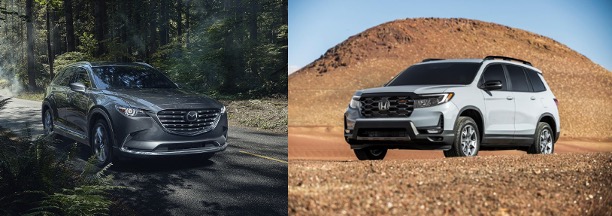
The 2023 Mazda CX-9 drops the base Sport trim and adds most of the previously optional Premium package (LED fog lights, moonroof and wireless charging pad) as standard. This package technically had also included a Bose sound system but due to supply constraints, the package deleted this feature and included a credit. As equipped the 2022 Mazda CX-9 Touring stickered at $39,985. The 2023 Mazda CX-9 Touring identically equipped only sees an increase of $40 to $40,025. However other trims see larger increases. For example the Signature trim increases in price by $900 to $49,735.
However, by dropping the Sport trim level and including the Premium package as standard to the Touring trim, the base model for the CX-9 increases by a total of $3,120 and no longer offers a model below $40k. And this is in addition to the change made for 2022 where all-wheel drive was made standard on the CX-9, previously a $1,900 option.
Similarly, Mazda has pushed other models upmarket like the Mazda3, which dropped its base motor, and other Mazda SUVs also dropped FWD variants, going AWD only. Mazda isn’t the only automaker both simplifying their lineup and cutting lower end features. Honda dropped the base trim on the Passport: the awkwardly named Passport Sport. And while the new base model EX-L increased in price by $1,630 for 2022, dropping the Sport trim effectively made the model’s starting price increase by $5,650.
This trend has been a long-time coming. Honda once offered a base DX trim not only on Civic but also on the Accord. Hard to imagine that Honda once offered a base model of its sedans that had crank windows, no air condition and even no radio. But as time moved on, it became less logical to offer a variant with a low price missing features consumers truly desired. And a lower profit base model simply to have a low advertising starting price started to fall out of favor. As automakers, Honda in particular, began to reduce the variations their models were produced in, these low profit trims were the first to be eliminated from the lineup.

But in the current era, with massive supply constraints limiting the total number of vehicles an automaker can produce, it makes sense to cut back even further, limiting supply to just higher profitable, higher priced trim levels. With virtually no discounting or rebates and even rampant dealer markups, it’s clear that most vehicles can support a higher price point. In economic terms, trim levels have always been an effort at price discrimination. Offering different bundles of features allowed automakers to attract consumers with different levels of demand for their given vehicle. More price sensitive customers would choose base models, less sensitive customers willing to pay more would opt for higher equipped models. But by the nature of the current marketplace, consumers are forced to either place orders months in advance, pay thousands in mark up or both.
If automakers felt this trend was temporary, they would continue throttling back the lower trims and simply producing more of the higher trims, higher optioned models. But by actually cutting the lower trims from the lineup to simplify, it demonstrates automaker sentiment that this trend is here to stay through the upcoming model year at a minimum. Should things change long-term and begin to revert back, automakers can always re-introduce lower trim levels again, but with used vehicle shortages poised to continue on long past new vehicle shortages, this isn’t a trend that is likely to reverse.
 The Autolytic